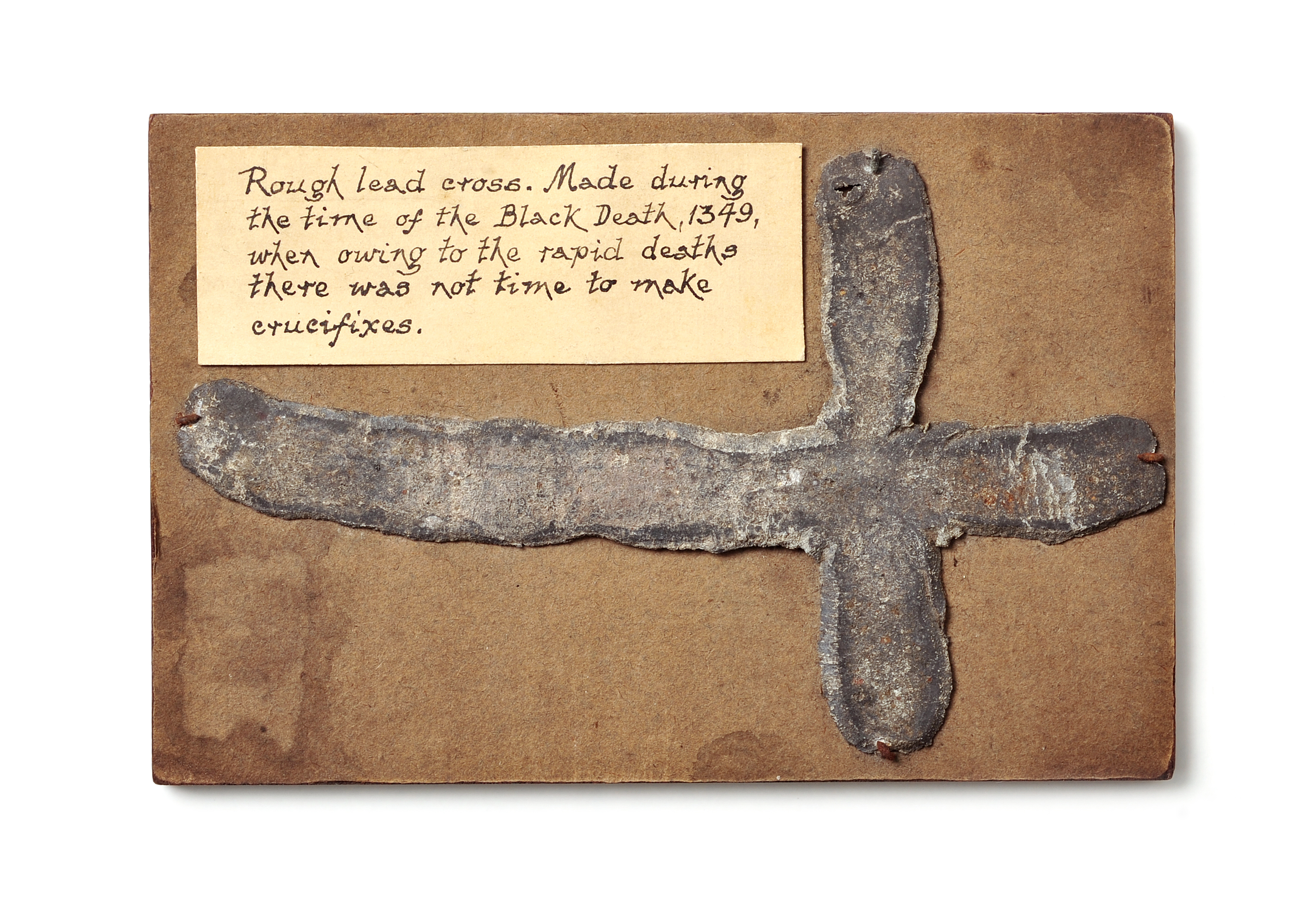
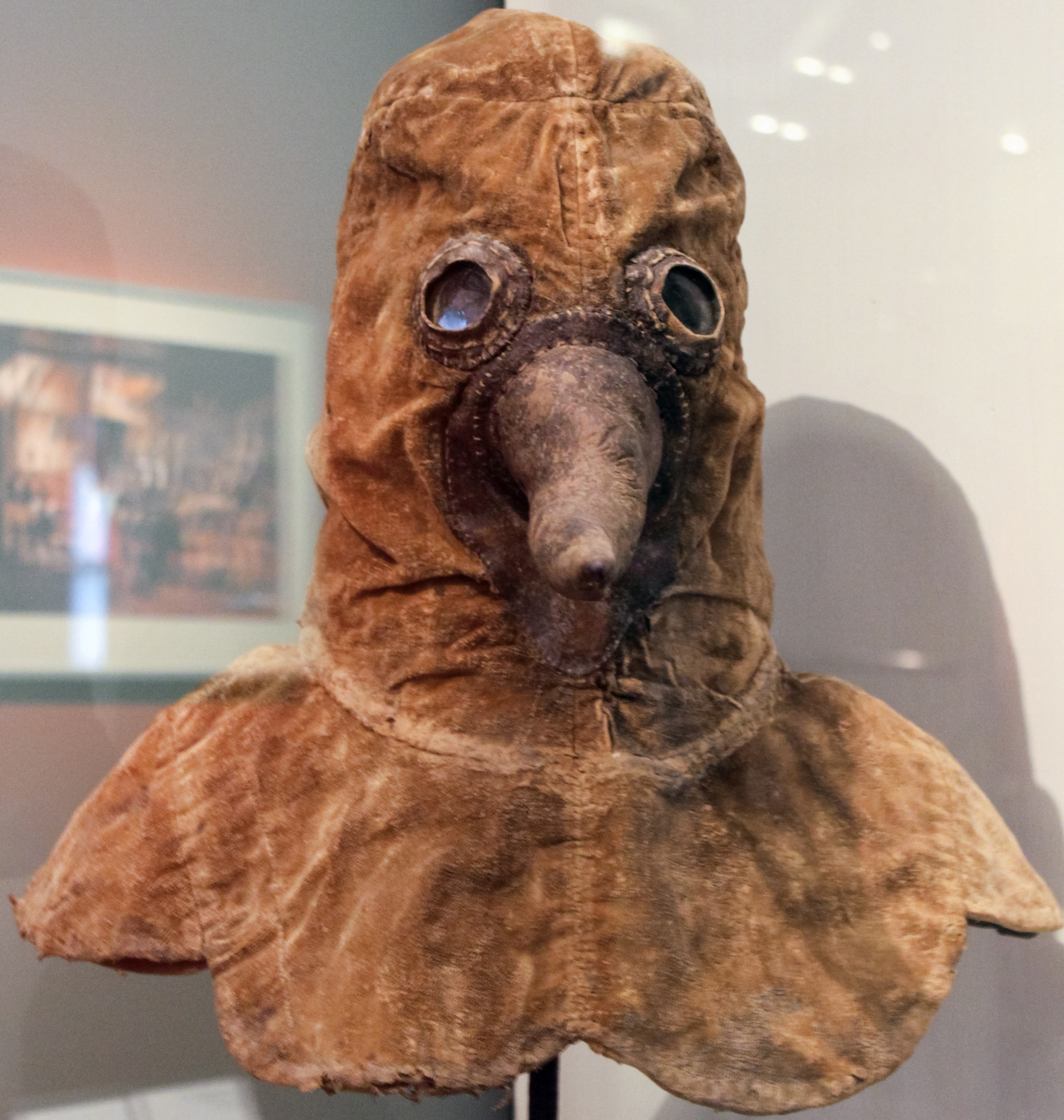
The Bubonic Plague, also known as the Black Death, killed at least 75 million people on three continents. Described as the most lethal epidemic in history, the plague began in China in the 1330s and made its way through Europe from 1346 to 1353. In those times, physicians didn't know what was causing the disease to spread, but they did know it was highly contagious. To provide medical care and to protect themselves, doctors of the time invented the medieval version of a hazmat suit. They were specifically hired by towns that had many plague victims in times of epidemics. Since the city was paying their salary, they treated everyone: both the rich and the poor.
The protective suit consisted of a heavy fabric overcoat that was waxed, a mask with glass eye openings and a cone nose shaped like a beak to hold scented substances and straw.
Some of the scented materials were ambergris, lemon Balm (Melissa officinalis), mint (Mentha spicata L.) leaves, camphor, cloves, laudanum, myrrh, rose petals, storax. This was thought to protect the doctor from miasmatic bad air.The straw provided a filter for the "bad air". A wooden cane pointer was used to help examine the patient without having to touch them. It was also used as a means of repenting sins, as many believed that the plague was a punishment and would ask to be whipped to repent their sins.
Chronicles and letters from the time describe the terror wrought by the illness. In Florence, the great Renaissance poet Petrarch was sure that they would not be believed: ‘O happy posterity, who will not experience such abysmal woe and will look upon our testimony as a fable.’ A Florentine chronicler relates that,
All the citizens did little else except to carry dead bodies to be buried [...] At every church they dug deep pits down to the water-table; and thus those who were poor who died during the night were bundled up quickly and thrown into the pit. In the morning when a large number of bodies were found in the pit, they took some earth and shovelled it down on top of them; and later others were placed on top of them and then another layer of earth, just as one makes lasagne with layers of pasta and cheese.
The tragedy was extraordinary. In the course of just a few months, 60 per cent of Florence’s population died from the plague, and probably the same proportion in Siena. In addition to the bald statistics, we come across profound personal tragedies: Petrarch lost to the Black Death his beloved Laura to whom he wrote his famous love poems; Di Tura tells us that ‘I [...] buried my five children with my own hands’.
 Importantly, plague was spread considerable distances by rat fleas on ships. Infected ship rats would die, but their fleas would often survive and find new rat hosts wherever they landed. Unlike human fleas, rat fleas are adapted to riding with their hosts; they readily also infest clothing of people entering affected houses and ride with them to other houses or localities. This gives plague epidemics a peculiar rhythm and pace of development and a characteristic pattern of dissemination. The fact that plague is transmitted by rat fleas means plague is a disease of the warmer seasons, disappearing during the winter, or at least lose most of their powers of spread. The peculiar seasonal pattern of plague has been observed everywhere and is a systematic feature also of the spread of the Black Death. In the plague history of Norway from the Black Death 1348-49 to the last outbreaks in 1654, comprising over thirty waves of plague, there was never a winter epidemic of plague. Plague is very different from airborne contagious diseases, which are spread directly between people by droplets: these thrive in cold weather.
With no accurate knowledge about the disease and the way it was spread, what could be done in the face of such horror? While many fled, others waited. Indeed, under Islamic doctrine, plague - being the will of God - was to be endured and fleeing was forbidden. Others, turning to religion for protection, formed themselves into wandering groups of penitents. They travelled from town to town, ritually flagellating themselves in public acts of repentance to a God who was clearly very angry. But violence could also be directed outwards. In mainland Europe outsiders and religious minorities - especially Jews - were subject to violent and vicious abuse.
Less disturbing, if equally useless, were the numerous plague ‘cures’. Strapping live chickens around plague buboes or drinking potions laced with mercury, arsenic or ground horn from the mythical unicorn did not help. Nor did carrying sweet-smelling flowers and herbs or ornate pomanders to purify the air. But amid the chaos, the pandemic prompted more useful responses - early public health measures to be expanded and then refined in the coming decades. For the Black Death should not be seen in isolation. It was the main event, a big bang. But it was also the herald for waves of lesser plague outbreaks that appeared regularly until well into the 1700s.
When the Black Death spread through Italy in late 1347, some ports began turning away ships suspected of coming from infected areas. During March the following year, authorities in Venice became the first to formalise such protective actions against plague, closing the city’s waters to suspect vessels, and subjecting travellers and legitimate ships to 30 days’ isolation. This period was extended to 40 days some years later - hence the term quarantine. Further regulations established remote cemeteries for plague victims who in turn were collected, transported and buried in accordance with defined rules. But these measures were too little, too late. Plague took hold and Venetians died in their tens of thousands.
.png)