Showing posts with label medieval. Show all posts

Vendel helmets - before norseman started to sail west.

In the dark times of Europe, when the whole contintent was still divided into hundreds of mini realms the brave men of north weren't ready to sail. From 6th till 8th century AD Norway and Sweden was in chaos. The later known Nordic kingdoms or ‘nations’ had not yet been developed during the Vendel age. Scandinavia was inhabited by numerous North Germanic tribes and clans who were almost in constant war with each other. Even the sub-tribes and clans of the larger tribes were politically independent from each other, constantly fighting one another. It seems that at times powerful warlords appeared establishing ephemeral principalities or kingdoms. This is the time and the societies described in the Anglo-Saxon epic poem Beowulf, an epic possibly of Jute or Gott/Gotar origins. We call this period as a Vendel, pre-Viking period. It's famous from very wealthy burial sites of norse elite warriors.


In this era the largest tribes of eastern and southern Scandinavia were the Svears, the Gotar and their probable branches – the Gauthigoth, Ostrogothae, Vagoth, Gutar, Theustes – the Jutes. Graves from Vendel (but also from other places) are very wealthy, what is interesting they are similar to famous anglo-saxon burial site: Sutton Hoo.

In 1881-1883 several excavations by Hjalmar Stolpe revealed 14 graves in and just beyond the south-east corner of Vendel churchyard. Several of the burials were contained in boats up to 9 metres long, and were richly furnished with arrangements of weapons (including fine swords), helmets, cauldrons and chains, beads, shields, tools, etc. Vendel has given its name to a period (the Vendel Age) in the Scandinavian Iron Age, and to the corresponding style in Art (the Vendel Style). It has often been suggested that the Germanic Vandals, or at least their kings or rulers, were connected to the site. In this it is coupled with the name of a companion site at Valsgärde in the same region. The close comparisons with the 27-metre ship burial at Sutton Hoo show a direct connection between the armourers producing work found at the two sites, a connection central to the understanding of both. The Sutton Hoo burial is often associated with King Raedwald of East Anglia, (ruled c 599-624), who in his later reign (c 616-624) was most powerful among the rulers of the English kingdoms.


The numerous tribes of the Vendel age gradually began to join in larger tribal unions or confederations, usually by force, while most Jutes, Angles and Northern Saxons of modern Denmark and Schleswig-Holstein had already migrated to Britain at the beginning of this period (starting at the early 5th century AD, of the pre-Vendel era). The Svear and the peoples of Scandinavia possibly related to the continental Goths – that is to say the Heruli (Heruls) and the Gotar (Gott Gutar and/or Geats) and their branches of modern Gotaland and the Oland & Gotland Islands (in modern southern Sweden) – went on living side by side during the Vendel period (550-793 AD) and the Viking age (793– early 11th century AD). Finally after several confrontations, around the 12th century they joined in a single kingdom, after all not being significantly different in language, origins and culture. Thereby they were both assimilated in the Swedish nation.


According to historians, the Viking Age began on June 8, A.D. 793, at an island monastery off the coast of northern England. Norseman started to sail. A contemporary chronicle recorded the moment with a brief entry: “The ravages of heathen men miserably destroyed God’s church on Lindisfarne, with plunder and slaughter.” The “heathen men” were Vikings, fierce warriors who sailed from Scandinavia and bore down on their prey in Europe and beyond in sleek, fast-sailing ships. In the centuries that followed, the Vikings’ vessels carried them deep into Russia and as far south as Constantinople, Sicily, and possibly even North Africa. They organized flotillas capable of carrying warriors across vast distances, and terrorized the English, Irish, and French coasts with lightning-fast raids. Exploratory voyages to the west took them all the way to North America.

Read More

Joyeuse -Charlemagne sword that made Europe.

Charlemagne—or Charles the Great—is one of the most important figures in European history. He was king of the Franks, a people living in what is known as France today. He was born in 742 AD, the son of the Frankish king Pepin the Short. He inherited the crown together with his brother Carloman in 768, but when Carloman passed away in 771, Charles became the sole ruler. His successes in defeating the Lombards and Saxons made the Pope declare Charles the first champion of the Catholic Church in 774. The next 20 years were full of warfare against Saxons, Lombard insurgents and the Moors of Spain. In the latter conflict, there was a Frankish campaign against the Moors in 778, where the legendary battle in the Pass of Roncevalles took place. In this battle, Charles' paladin Roland fell, breaking his sword "Durandal" and entered legend in the "Song of Roland". After the fall of the Roman Empire, he was the first to reunite Western Europe. He ruled a vast kingdom that encompassed what is now France, Germany, Italy, Austria, and the Low Countries, consolidating Christianity through his vast empire through forced conversions. His military ‘accomplishments’ frequently involved extreme brutality, such as the beheading of more than 2,500 Frankish and Saxon village chiefs.

Many things about Charlemagne's reign as King and as Emperor are memorable; among them is the legend of his sword - Joyeuse or "Joyful. Legend states that the sword of Joyeuse, meaning “joyful” in French, was forged by the famous blacksmith Galas, and took three years to complete.  The sword was described as having magical powers associated with it.  It was said to have been so bright that it could outshine the sun and blind its wielder's enemies in battle, and any person who wielded the legendary sword could not be poisoned.  The Emperor Charlemagne, coming back from Spain was said to have set up camp in the region and acquired the sword.

Beginning in the 13th Century, the ancient blade featured prominently in coronation rites of France’s rulers — a tradition that continued right up to the 1825 crowning of Charles X. There’s even a town in the south of the country named for the weapon. Over the years, Joyeuse underwent a series of restorations and upgrades. According to the Louvre, the pommel, cross guard and grip were all completely replaced between the 10th and 13th centuries. The steel itself was refurbished in the 19th Century, although portions of the original 3.6-pound, three-foot sword reportedly date back to the Early Medieval period.


There are other amazing artifacts of Charlemagne - talisman with a parts of True Cross in it. The talisman had two large cabochon sapphires. One was oval and the other was square. They were set into a remnant of the wood from the Holy Cross (the Cross of Jesus) and a small piece of the Virgin's hair. This talisman was buried with him at Aix-la-Chapelle, in 814, and re-discovered when the tomb was opened by Otto III in 1000. The talisman was then preserved in the treasury of the Cathedral until it was given, by the canons, to Empress Josephine in 1804, to wear at her coronation. 


Surprisingly, the real throne of Charlemagne looks quiet poor. Erected in the 790s, until 1531, it served as the coronation throne of the Kings of Germany, being used at a total of thirty-one coronations. The throne is very plain and simple and entirely free of elaboration. Six steps lead up to the seat, which is on a podium. The seat itself consists of four marble plates held together with bronze clamps. According to the modern theory, the marble and the steps were taken from the Church of the Holy Sepulchre in Jerusalem around 800. 


In the same Aachen Cathedral lies his grave. It was exhumed few times and what's rather unusal his bones survived to our times.  In 1000, Otto III, keen to present himself as the successor of the great man, had the burial vault opened. According to German chronicler and bishop Thietmar of Merseburg who was a contemporary of Otto’s, when the vault was opened they found Charlemagne’s uncorrupt body seated upon a marble throne wearing a crown with a scepter in his hand and the gospels open in his lap. Otto reportedly Helped himself to some of the relics and brought them to Rome. Frederick I Barbarossa was the next to disinter Charlemagne. In 1165, he had the remains exhumed and displayed as holy relics at the Aachen Court festival. In 1215, Frederick II had Charlemagne exhumed yet again. He commissioned local goldsmiths to make a rich gold casket to hold the bones. That’s the Karlsschrein originally in the placed in the center of the Palatine Chapel underneath a chandelier donated by Frederick Barbarossa in 1168. In 1349, some of his bones were removed to individual reliquaries by Holy Roman Emperor Charles IV. He had a gold reliquary made to contain a thigh bone, and the Bust of Charlemagne to contain the skullcap. Louis XI of France contributed to the trend in 1481 by commissioning the Arm Reliquary, a golden arm that contains the ulna and radius from Charlemagne’s right arm. It was scientists who took over from the emperors and kings. In 1861, Charlemagne’s remains were exhumed again so they could be studied. His skeleton was reconstructed and a very generous estimate (1.92 meters, or 6’4″) made of his height. In 1988, scientists exhumed his remains one more time, this time in secret. This study covered the bones in the reliquaries as well, a total of 94 bones and bone fragments, and they spent years meticulously examining and testing the collection. At 1.84 metres (six feet), he was unusually tall for his time. It's also estimated that his weight was at around 78 kilograms, giving him a slim body mass index of around 23. The average height for an adult male in the 9th century was 1.69 meters or 5’6″


Arm reliquary


Photo of Charlemagne bones from 1988 exhumation
Burial Shroud of Charlemagne. Made with murex snail dye, the famed purple favored by Roman emperors.

Read More

Bloody medieval warfare

On July 22, 1361, King Valdemar IV of Denmark sent an army of 2500 men ashore on Gotland's west coast. Gotland is an island that lies just ninety kilometers from the Swedish mainland, and for many centuries it played a dominant role in trade between Europe and Russia. Its walled town of Visby had been a member of the Hanseatic League since 1280. This league protected the economic interests of all cities within its membership along trade routes and each city had its own legal system and military force. By the middle of the fourteenth century the town had encroached into rural areas, this fact and its membership of the Hanseatic League had separated the city from the rest of the island and this had caused much antagonism between the town dwellers and those who lived in the countryside. By 1356, Visby had become less important within the Hanseatic community and this had not gone unnoticed by King Valdemar of Denmark who had seen the Hanseatic League become increasing powerful within his own country, angry that he had no control or any say within the trade route it protected, Valdemar made his way to Gotland. [Top image:

The citizens of Visby had somehow been warned, and had closed the gates. But 1800 peasants prepared to fight for their small country. It is unknown who commanded the Gutnish army. However, he was probably a minor noble of some standing, probably with military experience. The Danish army was composed mainly of Danish and German troops, many mercenaries from the Baltic coast of Germany, with recent experience in the various feuds and wars between the German and Scandinavian states.

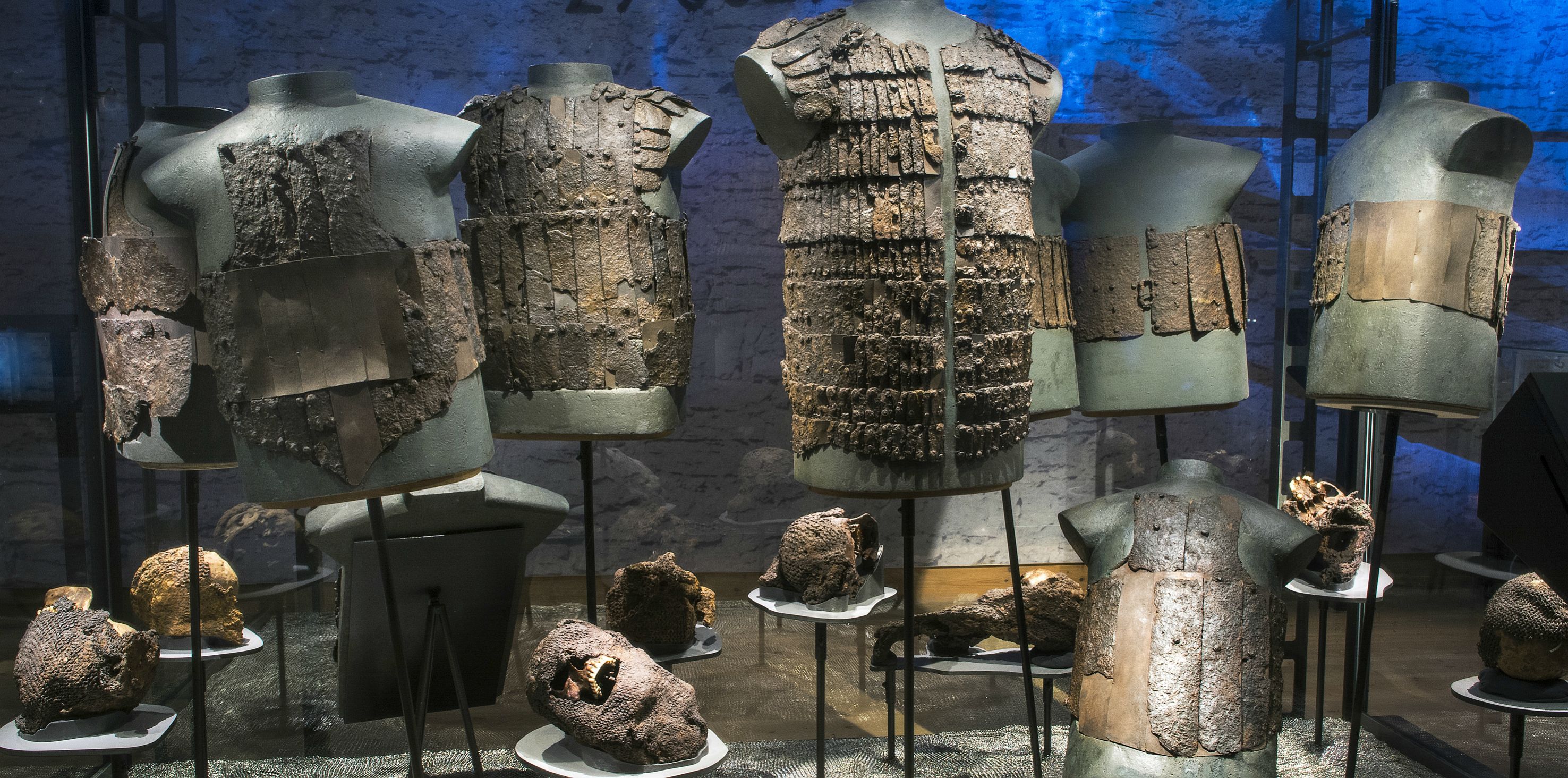
Simple peasants armor found in mass grave near city wall.

A legion of Swedish peasants tried to repel the Danish invasion near the city of Visby, but the inexperienced Gotlanders were no match for the Danish soldiers and many of them were slaughtered during the battle. Men, old folk, youths, cripples – they all die in battle outside the city walls of Visby. Their corpses are thrown into mass graves.

Nearly 700 years later a mass grave was found on the Island of Gotland and in the years up to 1928 at least three more pits were found. The final ones were found outside the gates of Visby, a walled city. Extensive archaeological investigations of the graves in 1928-1930 and modern science have provided new knowledge of what happened.

The dead of the peasant defenders were stripped of virtually anything of value and any arms or armour and then flung into pits where they had been despatched. Over 1185 human remains were found in pits excavated and many more are known about - some inaccessible.

Just a few were found still wearing minor bits of equipment such as skull with the mail coif still in position but many would have been very poorly equipped or armed.

There were 456 wounds with visible evidence of cutting weapons, such as swords and axes. There were 126 which were from piercing weapons such as arrows, lances and "morning stars" which were a wooden ball studded with metal spikes and attached to a short handle with a chain and these were used against head and shoulders from above. There were also an undisclosed number of crushing injuries by the mace and war hammer. The latter were also often used to finish off the wounded. [Left: Armoured glove, from the mass graves, Visby]

Cutting wounds were split into two groups, those which showed hacking evidence but finished at the bone and those which actually severed the bone were 29. For example in more than one case where a single well aimed blow with a sword had been aimed at the upper legs and gone straight through both severing them instantly. Some had evidence of more than one lesser blow before the killer blow was used either in or after the battle.

War hammers were also in evidence where a square section of the hammer head showing in the shape of the section of the skull which had been stove in. See the picture on the left which points to three bodkin arrow points which had penetrated the skull and two holes where a hammer had been used and the skull split between them.

Which came first is unknown. A number of guesses can be made such as two quick hammer blows to fell the man and the arrows landing after, or a hail of arrows which he had turned his back on and then later two hammer blows to put him out of his misery. Before stripping and dumping him with his mates. The grouping of the arrow heads is particularly spectacular and it makes one wonder if they used the tactic of a hail of arrows as in the later battle of Crecy where it is said the English Longbow men kept 100,000 arrows in the air at one time.

There is one skeleton of a man who has had both legs severed, and it appears to have been done with one blow! The blow landed on the right leg below the knee on the outside, and then struck the left leg slightly below and on the inside. Since it appears to be unreasonable that someone would stand still with one leg hewn off, that one blow cut off both legs below the knee. As can be seen in another section of this book, that is not so astounding after all. There are several skeletons where a foot has been severed, and there are many with cuts to the lower leg. Indeed, this seems to have been a major target. A rough estimate is that close to 70 percent of the blows detected at Visby were aimed at the lower leg. This is quite understandable, as the lower leg is hard to protect, even with a shield. When you consider that these fighters were not well equipped with leg defenses it explains why they were targeted. The head also took many blows. There are several skulls from Visby that received so many blows that you would think the enemy would have gotten tired of hitting the poor devils. Many of the skulls still have their mail hoods, and although the hoods did provide some protection, many of the blows cut through the mail and into the bone. One of the most unsettling skulls is one where the victim had been hit a sharp blow right at the bridge of the nose. The blow was so hard that it cut through the upper jaw.

Skull of peasant from Visby with three arrowheads


Crushed skull with riveted mail coif from the medieval battle of Visby. 


There is also a skull from a different battle that shows how brutal the fight were. The Battle of Towton was fought during the English Wars of the Roses on 29 March 1461, near the village of Towton in Yorkshire. It brought about a change of monarchs in England, with the victor, the Yorkist Edward, Duke of York—who became King Edward IV. 28 000 men died that one day.

The skull (left) of a warrior shows was crushed. The soldier  had survived battle before. A healed skull fracture points to previous engagements. He was old enough—somewhere between 36 and 45 when he died.

He suffered eight wounds to his head that day. The precise order can be worked out from the direction of fractures on his skull: when bone breaks, the cracks veer towards existing areas of weakness. The first five blows were delivered by a bladed weapon to the left-hand side of his head, presumably by a right-handed opponent standing in front of him. None is likely to have been lethal.


The next one almost certainly was. From behind him someone swung a blade towards his skull, carving a down-to-up trajectory through the air. The blow opened a huge horizontal gash into the back of his head—picture a slit you could post an envelope through. Fragments of bone were forced in to his brain. His enemies were not done yet. Another small blow to the right and back of the head may have been enough to turn him over onto his back. Finally another blade arced towards him. This one bisected his face, opening a crevice that ran from his left eye to his right jaw.

Read More

Fighting the Black Death


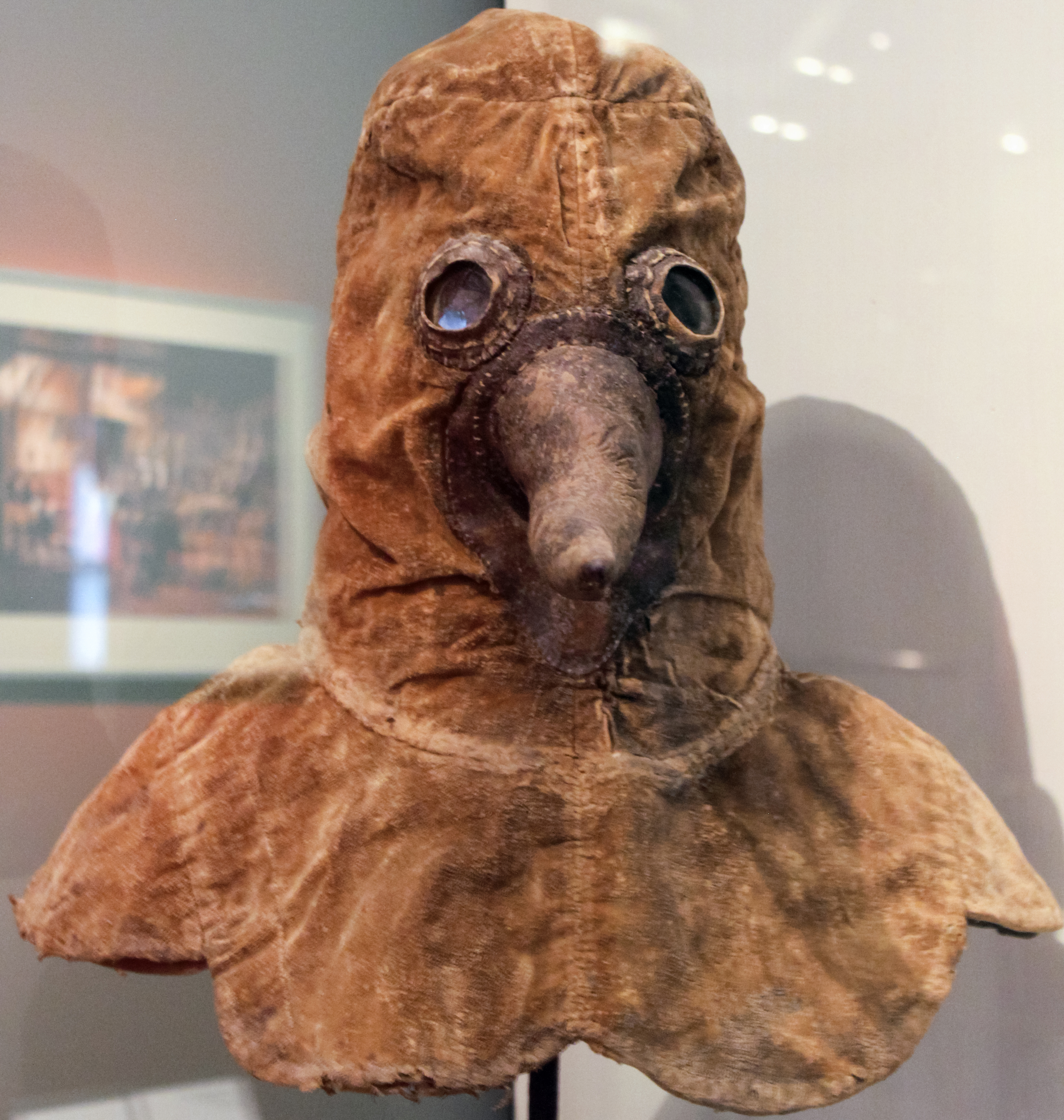
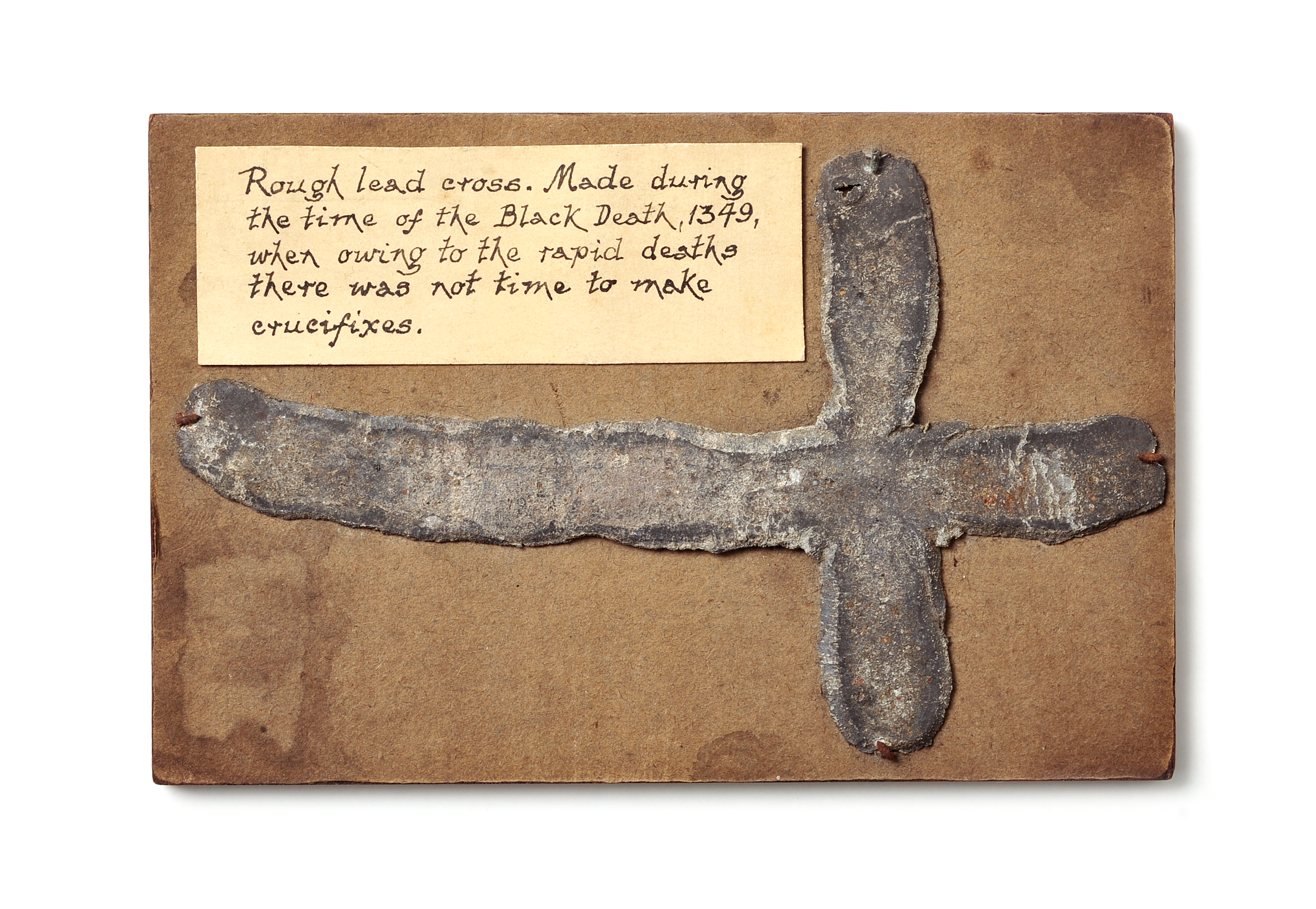
The Bubonic Plague, also known as the Black Death, killed at least 75 million people on three continents. Described as the most lethal epidemic in history, the plague began in China in the 1330s and made its way through Europe from 1346 to 1353. In those times, physicians didn't know what was causing the disease to spread, but they did know it was highly contagious. To provide medical care and to protect themselves, doctors of the time invented the medieval version of a hazmat suit. They were specifically hired by towns that had many plague victims in times of epidemics. Since the city was paying their salary, they treated everyone: both the rich and the poor.


The protective suit consisted of a heavy fabric overcoat that was waxed, a mask with glass eye openings and a cone nose shaped like a beak to hold scented substances and straw.

Some of the scented materials were ambergris, lemon Balm (Melissa officinalis), mint (Mentha spicata L.) leaves, camphor, cloves, laudanum, myrrh, rose petals, storax. This was thought to protect the doctor from miasmatic bad air.The straw provided a filter for the "bad air". A wooden cane pointer was used to help examine the patient without having to touch them. It was also used as a means of repenting sins, as many believed that the plague was a punishment and would ask to be whipped to repent their sins.


Chronicles and letters from the time describe the terror wrought by the illness. In Florence, the great Renaissance poet Petrarch was sure that they would not be believed: ‘O happy posterity, who will not experience such abysmal woe and will look upon our testimony as a fable.’ A Florentine chronicler relates that,

    All the citizens did little else except to carry dead bodies to be buried [...] At every church they dug deep pits down to the water-table; and thus those who were poor who died during the night were bundled up quickly and thrown into the pit. In the morning when a large number of bodies were found in the pit, they took some earth and shovelled it down on top of them; and later others were placed on top of them and then another layer of earth, just as one makes lasagne with layers of pasta and cheese.


The tragedy was extraordinary. In the course of just a few months, 60 per cent of Florence’s population died from the plague, and probably the same proportion in Siena. In addition to the bald statistics, we come across profound personal tragedies: Petrarch lost to the Black Death his beloved Laura to whom he wrote his famous love poems; Di Tura tells us that ‘I [...] buried my five children with my own hands’.


Importantly, plague was spread considerable distances by rat fleas on ships. Infected ship rats would die, but their fleas would often survive and find new rat hosts wherever they landed. Unlike human fleas, rat fleas are adapted to riding with their hosts; they readily also infest clothing of people entering affected houses and ride with them to other houses or localities. This gives plague epidemics a peculiar rhythm and pace of development and a characteristic pattern of dissemination. The fact that plague is transmitted by rat fleas means plague is a disease of the warmer seasons, disappearing during the winter, or at least lose most of their powers of spread. The peculiar seasonal pattern of plague has been observed everywhere and is a systematic feature also of the spread of the Black Death. In the plague history of Norway from the Black Death 1348-49 to the last outbreaks in 1654, comprising over thirty waves of plague, there was never a winter epidemic of plague. Plague is very different from airborne contagious diseases, which are spread directly between people by droplets: these thrive in cold weather.

With no accurate knowledge about the disease and the way it was spread, what could be done in the face of such horror? While many fled, others waited. Indeed, under Islamic doctrine, plague - being the will of God - was to be endured and fleeing was forbidden. Others, turning to religion for protection, formed themselves into wandering groups of penitents. They travelled from town to town, ritually flagellating themselves in public acts of repentance to a God who was clearly very angry. But violence could also be directed outwards. In mainland Europe outsiders and religious minorities - especially Jews - were subject to violent and vicious abuse.

Less disturbing, if equally useless, were the numerous plague ‘cures’. Strapping live chickens around plague buboes or drinking potions laced with mercury, arsenic or ground horn from the mythical unicorn did not help. Nor did carrying sweet-smelling flowers and herbs or ornate pomanders to purify the air. But amid the chaos, the pandemic prompted more useful responses - early public health measures to be expanded and then refined in the coming decades. For the Black Death should not be seen in isolation. It was the main event, a big bang. But it was also the herald for waves of lesser plague outbreaks that appeared regularly until well into the 1700s.

When the Black Death spread through Italy in late 1347, some ports began turning away ships suspected of coming from infected areas. During March the following year, authorities in Venice became the first to formalise such protective actions against plague, closing the city’s waters to suspect vessels, and subjecting travellers and legitimate ships to 30 days’ isolation. This period was extended to 40 days some years later - hence the term quarantine. Further regulations established remote cemeteries for plague victims who in turn were collected, transported and buried in accordance with defined rules. But these measures were too little, too late. Plague took hold and Venetians died in their tens of thousands.


Read More

Vikings.

Bold seafarers swept out of Scandinavia a millennium ago and terrorized and explored Europe, western Asia, and eastern Canada. They left us amazing artifacts.

From some 250 years most of the world fell prey to raiders called Vikings. Sailing from Scandinavia they terrorized and left their testimony in Europe, Asia and even North America. They dominated Russia and gave it its name, they crossed Atlantic 5 centuries before Columbus. They visited Constantinople, Greece, they sailed Volga. Even the names of the days came from Viking age gods - Thursday ( Thor's day) or Friday (Frigg)


In the Precopernican age everyone in Europe knew that the North Atlantic  led only to a turmoil of monsters at the end of the world. Only the crazy could cross this barrier. The Vikings. They colonized Iceland and Greenland (remains of their settlement on the left). At the end of first millenium ad the Greenland caprtain Bjarni Herjulfsson caosted a land with "well-wodden and with low hills" - America.


Four times the Viking fleet sailed the Black See and raided Constantinople (they called it Miklagard, the big city). They carved their runes in famous Hagia Sophia. Impressed, the Byzantine emperors recruited warriors as a part of their guard - Varagian Guard. They served Byzantium for 200 years. There is a suggestion that the Vikings were the dominant class of eastern countries. Some historians think that the first polish king - Mieszko was a viking. We know for sure that Norsemen assimilated into local population and then, they became Slavic. The Volga river was a rich trade road. And for the Norsemen it was also a source a trading exchange. The small buddha figure was found in Viking's grave at Helgo, Sweden with some Coptic (Egyptian) landle and irish cozier.


In 859 two chieftains Bjorn and Hasteinn with 62 ship made an amazing voyage. Following the bay of Biscay (France), they looted the Iberian coast, paused near the rock of Gibraltar (and plundered Moroccan city of Algerciras). Then, first time in history they sailed Mediterranean following North Africa coast. They captured their first ever dark-skinned slaves (they called them blue-men). Left: 9th century Swedish engraved silver ring shows evidence of close contacts between Viking Age Scandinavians and the Islamic world. The ring is set with a piece of imported coloured glass that is inscribed with Arabic writing that reads "For/To Allah" 

Inching the north Atlantic Norse settlers reached Greenland around the end of 10th century. The first Viking that landed in North America was Leif the Lucky. He came to a mass of mountains and glaciers which he named Vinland. Further south he came to a flat land with a lot of trees and grassland. Leif built a house and wintered there. We do not know for sure where did he landed but it is probably Labrador. Another Viking explored the new continent even further. His party came upon "three sin boats and three men under each". He probably met Eskimos or Indians. The Norse planned to colonize new lands. Early in 11th century Thorfinn prepared three ships loaded with 65 people and sailed to the west. His colony stood for two years. In the meantime his wife gave birth to a boy called Snorri - he was the first white child born in the America.
With all these battle that they fought there is only one Viking helmet that survived - from Gjermundbu mound burial. This helmet was made of iron and was in the shape of a rounded or peaked cap made from four plates after the spangenhelm pattern. The helmet has a rounded cap and has a "spectacle" guard around the eyes and nose which formed a sort of mask. So no horns.


When not fighting or travelling they set aside time for fests and games. Board games and dice games were played as a popular pastime, at all levels of society. Preserved gaming pieces and boards show game boards made of easily available materials like wood, with game pieces manufactured from stone, wood or bone, while other finds include elaborately carved boards and game pieces of glass, amber, antler or walrus tusk, together with materials of foreign origin, such as ivory. The Vikings played several types of tafl games; hnefatafl, nitavl (Nine Men's Morris) and the less common kvatrutafl. Chess also appeared at the end of the Viking Age. Hnefatafl is a war game, in which the object is to capture the king piece – a large hostile army threatens and the king's men have to protect the king. It was played on a board with squares using black and white pieces, with moves made according to dice rolls. The Ockelbo Runestone shows two men engaged in Hnefatafl, and the sagas suggest that money or valuables could have been involved in some dice games. Left: Glass board game pieces.


During the Viking Age, Scandinavian men and women travelled to many parts of Europe and beyond, in a cultural diaspora that left its traces from Newfoundland to Byzantium. This period of energetic activity also had a pronounced effect in the Scandinavian homelands, which were subject to a variety of new influences. In the 300 years from the late 8th century, when contemporary chroniclers first commented on the appearance of Viking raiders, to the end of the 11th century, Scandinavia underwent profound cultural changes. By the late 11th century, royal dynasties legitimised by the Catholic Church (which had had little influence in Scandinavia 300 years earlier) were asserting their power with increasing authority and ambition, and the three kingdoms of Denmark, Norway, and Sweden had taken shape. Towns appeared that functioned as secular and ecclesiastical administrative centres and market sites, and monetary economies began to emerge based on English and German models. That was the end of Viking era.


Read More

Viking ring fortess

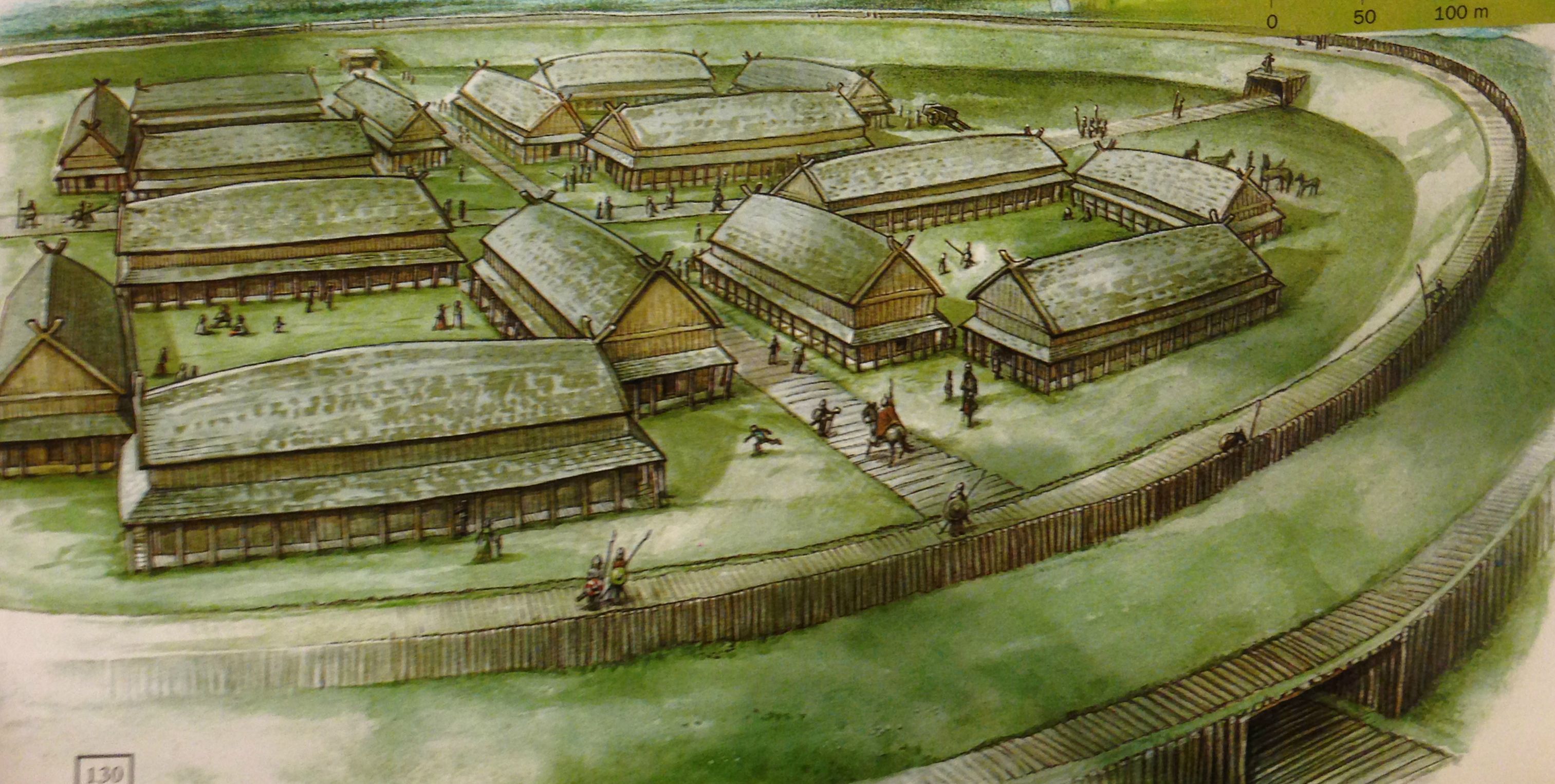
When the Viking ring (also known as Trelleborg) fortresses were discovered in Denmark, researchers were surprised: to a great extent, it came to light that they had previously underestimated both the Vikings’ organizational and technical capabilities of building military installations that would keep their enemies at a distance.

Eight of them have been dated to around 980 CE – the reign of King Gorm the Old’s son, King Harald I Bluetooth of Denmark (from who the Bluetooth technology has it's name).


These are:

-Aggersborg near Limfjorden, Denmark.
-Borgeby north of Lund at Lödde Å in Skåne, modern Sweden.
-Borrering near Køge, Zealand, Denmark
-Fyrkat near Hobro, Denmark.
-Nonnebakken in Odense, Denmark.
-Trelleborg near Slagelse, Denmark.
-Trelleborgen in Trelleborg, Skåne, modern Sweden
-Rygge, Østfold, Norway

The fortresses are characterized by a ring rampart with an appurtenant moat and four covering gate openings. They had a rigorous geometric street system, a division of the internal surface area into four square-shaped blocks. Within each of these blocks, there were four longhouses positioned in the form of farmhouses constructed around a quadrangle. All of the four facilities have a uniform and rigorous geometric architecture and a stringent symmetry, which clearly manifests itself in the fortifications’ circular forms and the gate openings’ placement with respect to the four corners of the world. Some historians think that the geometric design of the Trellenborgs was inspired by old Roman army camps. It has been estimated that the Trelleborg fortresses were built sometime around the year 980 A.D. However, it seems plausible to assume that the fortresses might not have been in existence for very long. And maybe they were operative for only a few years. We are quite sure, for example, that Fyrkat was wiped out after a raging conflagration and that it was not rebuilt.

Notwithstanding their homogeneity, each one of the fortresses has its own individual constructional features. The diameter of Aggersborg, for example, is 240 meters, which is roughly twice that of the other fortresses. At Trelleborg, there is a bailey consisting of 15 longhouses and protected by an outer rampart of its own, as well a trench. Cemeteries with remains of the Viking Era have been found at Fyrkat and Trelleborg.


When one arrived as a visitor to the fortresses, they must have appeared overwhelmingly impressive on account of their earthworks, their thick wooden palisades and their high moats and they probably seemed virtually impossible to conquer.

One moved through the gateway of the fortress and the ring ramparts, from where the guards stood and kept watch on whomever was arriving and suddenly found him/herself standing in the midst of the fortress’s layout, which was teeming with life. Taking the standards of the past into consideration, the houses, measuring more than 7 meters in width and almost 30 meters in length, with their outwardly bulging long walls, must have made their effect on the viewer as large halls of some sort.

When we also take into account that at Trelleborg and Fyrkat, there were four square-shaped blocks arranged around quadrangles while at Aggersborg, there were sixteen such square-shaped blocks with longhouses, it is easy to envision and sense the power that lay behind the construction of these fortresses.

The longhouses themselves were divided into three rooms, of which the middle room measured about 20 meters in length and was, in a number of instances, fitted with a langild (a long Iron Age/Viking fireplace, as opposed to a round or square one). Here the Vikings’ troops were quartered. It was here that they slept, repaired their personal equipment and played games that involved tossing dice.

From several of the halls, shouting, singing and laughter could be heard. But not all the houses were used as residences. From the blacksmith’s workshop, the hammer’s clanking against the anvil mingled with the joyful shouts and inside the storehouse buildings, the arithmetician might have quietly and calmly been busy checking on the army’s supplies – the rations would have to last for the whole winter. The short life and rapid abandonment of these fortress shows that political change at the end of the 10th century must have made them unnecessary.


reconstruction of the wall


Read More

Did the Aztecs really practice human sacrifice?

Yes they did. And they were really cruel.

The Aztec civilization which flourished in Mesoamerica between 1345 and 1521 CE has gained an infamous reputation for bloodthirsty human sacrifice with lurid tales of the beating heart being ripped from the still-conscious victim, decapitation, skinning and dismemberment. All of these things did happen but it is important to remember that for the Aztecs the act of sacrifice - of which human sacrifice was only a part - was a strictly ritualised process which gave the highest possible honour to the gods and was regarded as a necessity to ensure mankind’s continued prosperity. The Aztec gods and goddesses also required the living hearts of humans for nourishment. All hearts were good, but the bravest captives were considered to be particularly nourishing to the Aztec gods.

Their chief god was Huitzilpochtli (the Hummingbird Wizard) who represented the sun, the warrior, and fought the Aztecs' battles with the other gods to ensure the Aztecs' survival. Huitzilpochtli needed food to nourish him so he could continue to fight. His preferred food was human blood. In order to keep feeding Huitzilpochtli, the Aztecs warred continuously. Their army was of the utmost importance, and they had several different factions of warriors. The Knights of the Eagle and the Knights of the Jaguar were two such bodies of troops. These were the men who went forth to capture suitable human sacrifices. Another source of sacrificial victims was the ritual ball-games where the losing captain or even the entire team paid the ultimate price for defeat. Children too could be sacrificed, in particular, to honour the rain god Tlaloc in ceremonies held on sacred mountains. It was believed that the very tears of the child victims would propitiate rain. Slaves were another social group from which sacrificial victims were chosen, they could accompany their ruler in death or be given in offering by tradesmen to ensure prosperity in business.

The killing was bloody. The most important place where sacrifices occurred was the Huey Teocalli, the Templo Mayor (Great Temple) of Tenochtitlan. Here a specialized priest with a sharp sharp knife removed the heart (by cutting below the chest) from the victim and the body was thrown down the steps of the pyramid, while his head was cut off and placed on the tzompantli, or skull rack. However, not all sacrifices took place on top of pyramids. In some cases mock-battles were organized between the victim and a priest, where the priest fought with real weapons and the victim, tied to a stone or a wooden frame, fought with wooden or feathered ones. Children sacrificed to Tlaloc were often carried to the god’s sanctuaries on top of the mountains that surround Tenochtitlan and the Basin of Mexico in order to be offered to the god. Those sacrificed to Xipe Totec were also skinned, most probably in imitation of seeds shedding their husks.

Estimates suggest 20,000 people a year were sacrificed by the Aztec royalty. After the sacrifice, the heads of victims could be displayed in racks (tzompantli), depictions of which survive in stone architectural decoration, notably at Tenochtitlán. The flesh of those sacrificed was also, on occasion, eaten by the priests conducting the sacrifice and by members of the ruling elite or warriors who had themselves captured the victims.


Top images: Aztec human skulls with decorated with the mosaics

A jaguar-shaped cuauhxicalli.
This altar-like stone vessel was used to hold the hearts of sacrificial victims.


Tecpatl obsidian sacrificial knife, Aztec

Mosaic ceremonial knife


Aztec zoomorphic death whistle, click on image to listen


Read More

War elephants


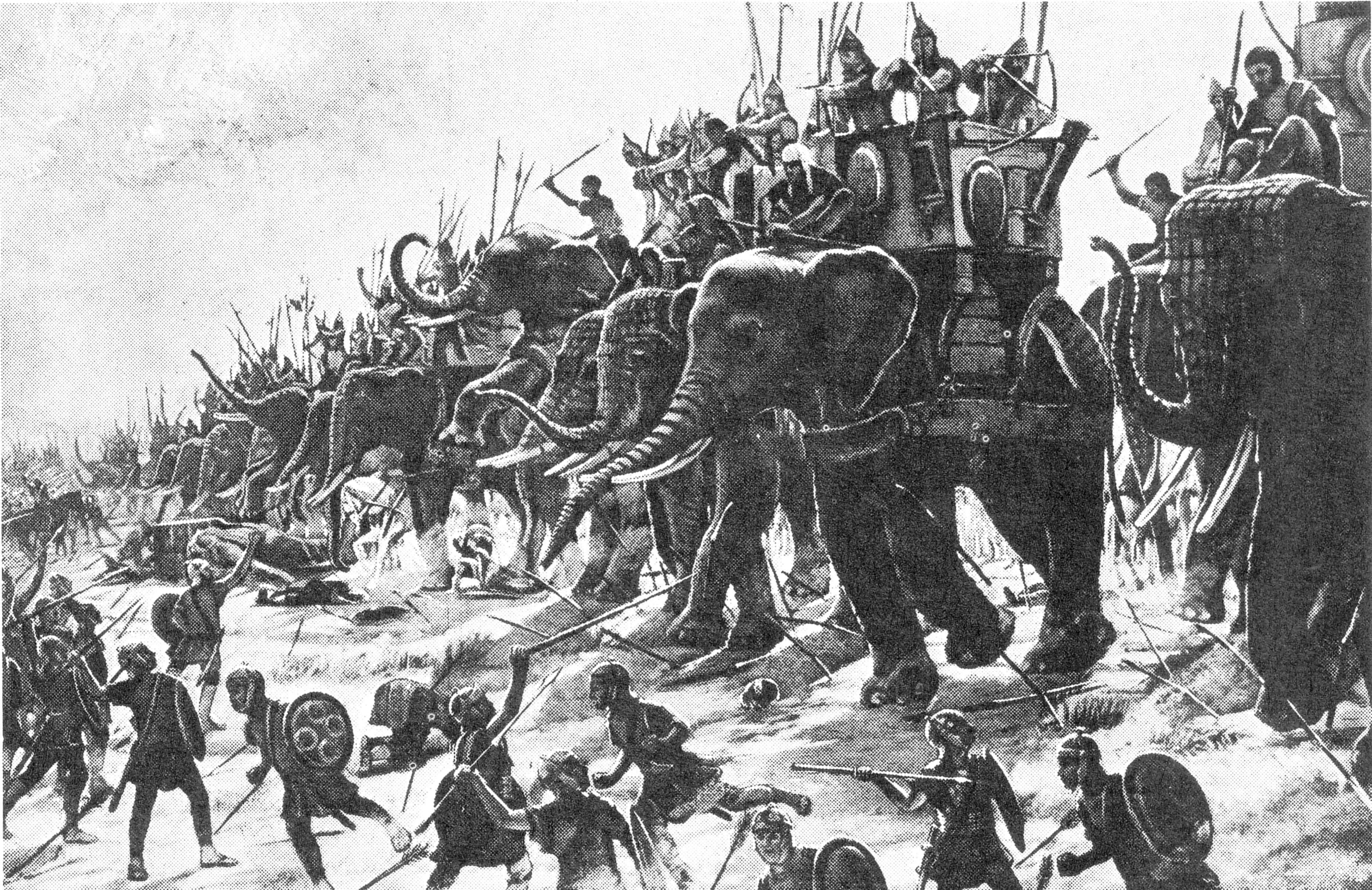
It was the arrival of the cannon in the 16th century that finally heralded the end of elephants being used as an instrument of war. Until that time, from as early as 1000BC, they trampled across battlefields around the globe, through wars in places as far flung as Yemen and Sri Lanka. 


The use of elephants in battle spread from India to Persia, and the first encounter between European forces and pachyderms took place in what is now Northern Iraq, with Alexander the Great winning a decisive victory against Darius III of Persia.
Evidently, the fifteen elephants deployed by the Persian forces were not enough to secure victory – Alexander left the battlefield having conquered Babylon and most of Persia.


The impact of the giant beasts of war did not go unnoticed by the legendary Macedonian king, who took them into his own army. The terror that the unfamiliar smell and sight of the elephants had on the cavalry proved to be a useful tool for Alexander in further battles, and he went on to control as many as 100 war elephants.

War elephants were introduced to the Mediterranean by King Pyrrhus of Epirus. He brought twenty to attack the Romans at the battle of Heraclea in 280BC and won decisively because the Roman’s were unprepared for the war elephants. 

An elephant sword, these were attached to the tusks of war elephants. India 15-17th C.
Widely acknowledged as one of the greatest military leaders in history, the Carthaginian general Hannibal famously invaded Italy from the north in 218 B.C., crossing the Alps from Gaul with an army of foot-soldiers, cavalry and a handful of north African forest elephants, smaller than the Asian and African elephants familiar to today’s zoo-goers. Of the six elephants that survived the arduous mountain trek, five died the following winter. The sixth, a one-tusked elephant named Surus, became Hannibal’s mount and mobile viewing platform in the marshes of the Arno. Over the next 15 years, Hannibal won significant battles and occupied much of Italy, sometimes with reinforcement elephants shipped directly from Africa. In a 209 B.C. battle with the Roman consul Marcellus, Hannibal’s war elephants created havoc until the Romans managed to wound one, touching off a cascade of panic among the pachyderms.

The Delhi Sultanate used war elephants against the Mongol hoards led by Timur Khan in 1398; however the Indian forces were defeated. It is unknown exactly how Timur managed to solve the problems caused by the 120 elephants he encountered; one legend states that he attached straw to his camels so that when the giants of the animal kingdom got close, he could set the straw on fire, causing the camels to run forward. 

From the sixteenth century, the use of gun powder in battle made it considerably easier to bring down the animals, diminishing their effectiveness and bringing an end to their use on the battlefield. However they continued to be used for transportation and logistics in warfare right up to the Second World War, where they were used by Indian and Burma forces to transport guns and supplies, and to assist in engineering projects such as road and bridge building in remote areas where vehicles could not be used.

Illustration of a lion, leopard, rabbit, and elephant from memory/description,
taken from Tractatus de Herbis (Italy ca. 1440)
Ancient roman bed decoration depicting war elephant. 1st century AD 


This fabulous 17th century armour is composed of 5,840 plates and weighs 118kg, some plates are missing and originally the total number would be 8,439 and weigh 159kg! The tusk swords that accompany this armour (not on display) weigh in at 10kg.


Read More

Viking's unlucky trip to Dorset

In 2009 during the construction of the Weymouth Relief Road in Dorset archaeologists from Oxford made one of the most exciting, and disturbing, archaeological discoveries in Britain in recent years.

They have found a mass grave of 54 skeletons and 51 heads of men executed some time between AD 910 and 1030. Naked, beheaded, and tangled, the bodies of 51 young males  have been identified as brutally slain Vikings. For more than 1,000 years this bloody roadside act was forgotten, one of many atrocities in the long and violent struggle between the Anglo-Saxons and the Norse invaders. On November 13, A.D. 1002, Æthelred Unræd, ruler of the English kingdom of Wessex, “ordered slain all the Danish men who were in England,” according to a royal charter. This drastic step was not taken on a whim, but was the product of 200 years of Anglo-Saxon frustration and fear.

The 54 skeletons were all of males, almost all aged from their late teens to around 25 years old, with a handful of older individuals. They had all been killed at the same time with a large, very sharp weapon such as a sword. They had not been cleanly killed, as many of them had suffered multiple blows to the vertebrae, jawbones and skulls. One man had his hands sliced through, suggesting that he had attempted to grab the sword as it was being swung towards him.

They had no obvious battle wounds and were most likely captives. Judging from the lack of any remains of clothing or other possessions, they had probably been naked when they were thrown into the pit. There are more bodies than skulls, suggesting that a couple of the heads – perhaps of high-ranking individuals – were kept as souvenirs or put on stakes.

A chemical analysis of teeth from ten of the men showed they grew up in countries where the climate is far colder than Britain - with one individual thought to have come from within the Arctic Circle. Now we know that they were Viking mercenaries. We know that for their teeth, which some of them had grooves filed into his two front teeth. Archaeologists think it may have been designed to frighten opponents or show status as a great fighter. This is a typical for Jomsvikings, a group of warriors from eastern Denmark who were feared across Europe and became so notorious they spawned their own saga. The Jomsvikings were forbidden from showing fear, and if executed would request to face the blow as proof of their bravery.


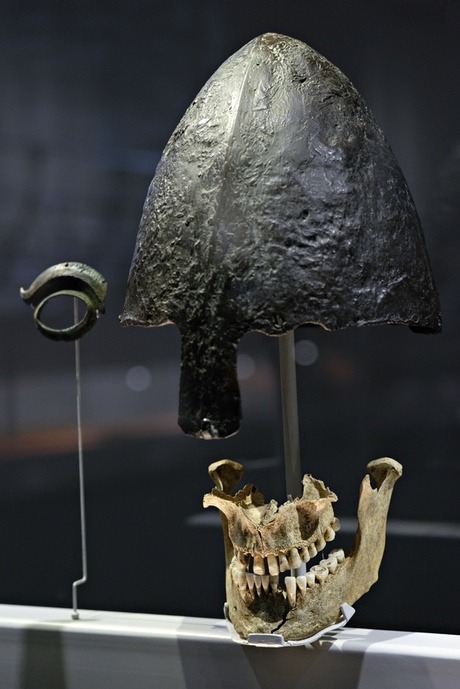
Few kilometers from the mass execution archaeologist have found helmet, axe and jawbone belonging to high rank Viking. There is a speculation that it's one of three missing heads from the Dorset execution. Maybe a leader of band whose head was taken as a trophy? Dating of the helmet gave us an answer that it's highly possible. 

Not only is it one of the most dramatic Viking finds of recent years, it is particularly important in providing a very different perspective to the usual view of Viking military success in England in that period


Read More
Powered by Blogger.

Popular Posts