Showing posts with label viking. Show all posts

Vendel helmets - before norseman started to sail west.

In the dark times of Europe, when the whole contintent was still divided into hundreds of mini realms the brave men of north weren't ready to sail. From 6th till 8th century AD Norway and Sweden was in chaos. The later known Nordic kingdoms or ‘nations’ had not yet been developed during the Vendel age. Scandinavia was inhabited by numerous North Germanic tribes and clans who were almost in constant war with each other. Even the sub-tribes and clans of the larger tribes were politically independent from each other, constantly fighting one another. It seems that at times powerful warlords appeared establishing ephemeral principalities or kingdoms. This is the time and the societies described in the Anglo-Saxon epic poem Beowulf, an epic possibly of Jute or Gott/Gotar origins. We call this period as a Vendel, pre-Viking period. It's famous from very wealthy burial sites of norse elite warriors.


In this era the largest tribes of eastern and southern Scandinavia were the Svears, the Gotar and their probable branches – the Gauthigoth, Ostrogothae, Vagoth, Gutar, Theustes – the Jutes. Graves from Vendel (but also from other places) are very wealthy, what is interesting they are similar to famous anglo-saxon burial site: Sutton Hoo.

In 1881-1883 several excavations by Hjalmar Stolpe revealed 14 graves in and just beyond the south-east corner of Vendel churchyard. Several of the burials were contained in boats up to 9 metres long, and were richly furnished with arrangements of weapons (including fine swords), helmets, cauldrons and chains, beads, shields, tools, etc. Vendel has given its name to a period (the Vendel Age) in the Scandinavian Iron Age, and to the corresponding style in Art (the Vendel Style). It has often been suggested that the Germanic Vandals, or at least their kings or rulers, were connected to the site. In this it is coupled with the name of a companion site at Valsgärde in the same region. The close comparisons with the 27-metre ship burial at Sutton Hoo show a direct connection between the armourers producing work found at the two sites, a connection central to the understanding of both. The Sutton Hoo burial is often associated with King Raedwald of East Anglia, (ruled c 599-624), who in his later reign (c 616-624) was most powerful among the rulers of the English kingdoms.


The numerous tribes of the Vendel age gradually began to join in larger tribal unions or confederations, usually by force, while most Jutes, Angles and Northern Saxons of modern Denmark and Schleswig-Holstein had already migrated to Britain at the beginning of this period (starting at the early 5th century AD, of the pre-Vendel era). The Svear and the peoples of Scandinavia possibly related to the continental Goths – that is to say the Heruli (Heruls) and the Gotar (Gott Gutar and/or Geats) and their branches of modern Gotaland and the Oland & Gotland Islands (in modern southern Sweden) – went on living side by side during the Vendel period (550-793 AD) and the Viking age (793– early 11th century AD). Finally after several confrontations, around the 12th century they joined in a single kingdom, after all not being significantly different in language, origins and culture. Thereby they were both assimilated in the Swedish nation.


According to historians, the Viking Age began on June 8, A.D. 793, at an island monastery off the coast of northern England. Norseman started to sail. A contemporary chronicle recorded the moment with a brief entry: “The ravages of heathen men miserably destroyed God’s church on Lindisfarne, with plunder and slaughter.” The “heathen men” were Vikings, fierce warriors who sailed from Scandinavia and bore down on their prey in Europe and beyond in sleek, fast-sailing ships. In the centuries that followed, the Vikings’ vessels carried them deep into Russia and as far south as Constantinople, Sicily, and possibly even North Africa. They organized flotillas capable of carrying warriors across vast distances, and terrorized the English, Irish, and French coasts with lightning-fast raids. Exploratory voyages to the west took them all the way to North America.

Read More

Vikings.

Bold seafarers swept out of Scandinavia a millennium ago and terrorized and explored Europe, western Asia, and eastern Canada. They left us amazing artifacts.

From some 250 years most of the world fell prey to raiders called Vikings. Sailing from Scandinavia they terrorized and left their testimony in Europe, Asia and even North America. They dominated Russia and gave it its name, they crossed Atlantic 5 centuries before Columbus. They visited Constantinople, Greece, they sailed Volga. Even the names of the days came from Viking age gods - Thursday ( Thor's day) or Friday (Frigg)


In the Precopernican age everyone in Europe knew that the North Atlantic  led only to a turmoil of monsters at the end of the world. Only the crazy could cross this barrier. The Vikings. They colonized Iceland and Greenland (remains of their settlement on the left). At the end of first millenium ad the Greenland caprtain Bjarni Herjulfsson caosted a land with "well-wodden and with low hills" - America.


Four times the Viking fleet sailed the Black See and raided Constantinople (they called it Miklagard, the big city). They carved their runes in famous Hagia Sophia. Impressed, the Byzantine emperors recruited warriors as a part of their guard - Varagian Guard. They served Byzantium for 200 years. There is a suggestion that the Vikings were the dominant class of eastern countries. Some historians think that the first polish king - Mieszko was a viking. We know for sure that Norsemen assimilated into local population and then, they became Slavic. The Volga river was a rich trade road. And for the Norsemen it was also a source a trading exchange. The small buddha figure was found in Viking's grave at Helgo, Sweden with some Coptic (Egyptian) landle and irish cozier.


In 859 two chieftains Bjorn and Hasteinn with 62 ship made an amazing voyage. Following the bay of Biscay (France), they looted the Iberian coast, paused near the rock of Gibraltar (and plundered Moroccan city of Algerciras). Then, first time in history they sailed Mediterranean following North Africa coast. They captured their first ever dark-skinned slaves (they called them blue-men). Left: 9th century Swedish engraved silver ring shows evidence of close contacts between Viking Age Scandinavians and the Islamic world. The ring is set with a piece of imported coloured glass that is inscribed with Arabic writing that reads "For/To Allah" 

Inching the north Atlantic Norse settlers reached Greenland around the end of 10th century. The first Viking that landed in North America was Leif the Lucky. He came to a mass of mountains and glaciers which he named Vinland. Further south he came to a flat land with a lot of trees and grassland. Leif built a house and wintered there. We do not know for sure where did he landed but it is probably Labrador. Another Viking explored the new continent even further. His party came upon "three sin boats and three men under each". He probably met Eskimos or Indians. The Norse planned to colonize new lands. Early in 11th century Thorfinn prepared three ships loaded with 65 people and sailed to the west. His colony stood for two years. In the meantime his wife gave birth to a boy called Snorri - he was the first white child born in the America.

With all these battle that they fought there is only one Viking helmet that survived - from Gjermundbu mound burial. This helmet was made of iron and was in the shape of a rounded or peaked cap made from four plates after the spangenhelm pattern. The helmet has a rounded cap and has a "spectacle" guard around the eyes and nose which formed a sort of mask. So no horns.


When not fighting or travelling they set aside time for fests and games. Board games and dice games were played as a popular pastime, at all levels of society. Preserved gaming pieces and boards show game boards made of easily available materials like wood, with game pieces manufactured from stone, wood or bone, while other finds include elaborately carved boards and game pieces of glass, amber, antler or walrus tusk, together with materials of foreign origin, such as ivory. The Vikings played several types of tafl games; hnefatafl, nitavl (Nine Men's Morris) and the less common kvatrutafl. Chess also appeared at the end of the Viking Age. Hnefatafl is a war game, in which the object is to capture the king piece – a large hostile army threatens and the king's men have to protect the king. It was played on a board with squares using black and white pieces, with moves made according to dice rolls. The Ockelbo Runestone shows two men engaged in Hnefatafl, and the sagas suggest that money or valuables could have been involved in some dice games. Left: Glass board game pieces.


During the Viking Age, Scandinavian men and women travelled to many parts of Europe and beyond, in a cultural diaspora that left its traces from Newfoundland to Byzantium. This period of energetic activity also had a pronounced effect in the Scandinavian homelands, which were subject to a variety of new influences. In the 300 years from the late 8th century, when contemporary chroniclers first commented on the appearance of Viking raiders, to the end of the 11th century, Scandinavia underwent profound cultural changes. By the late 11th century, royal dynasties legitimised by the Catholic Church (which had had little influence in Scandinavia 300 years earlier) were asserting their power with increasing authority and ambition, and the three kingdoms of Denmark, Norway, and Sweden had taken shape. Towns appeared that functioned as secular and ecclesiastical administrative centres and market sites, and monetary economies began to emerge based on English and German models. That was the end of Viking era.


Read More

Viking ring fortess

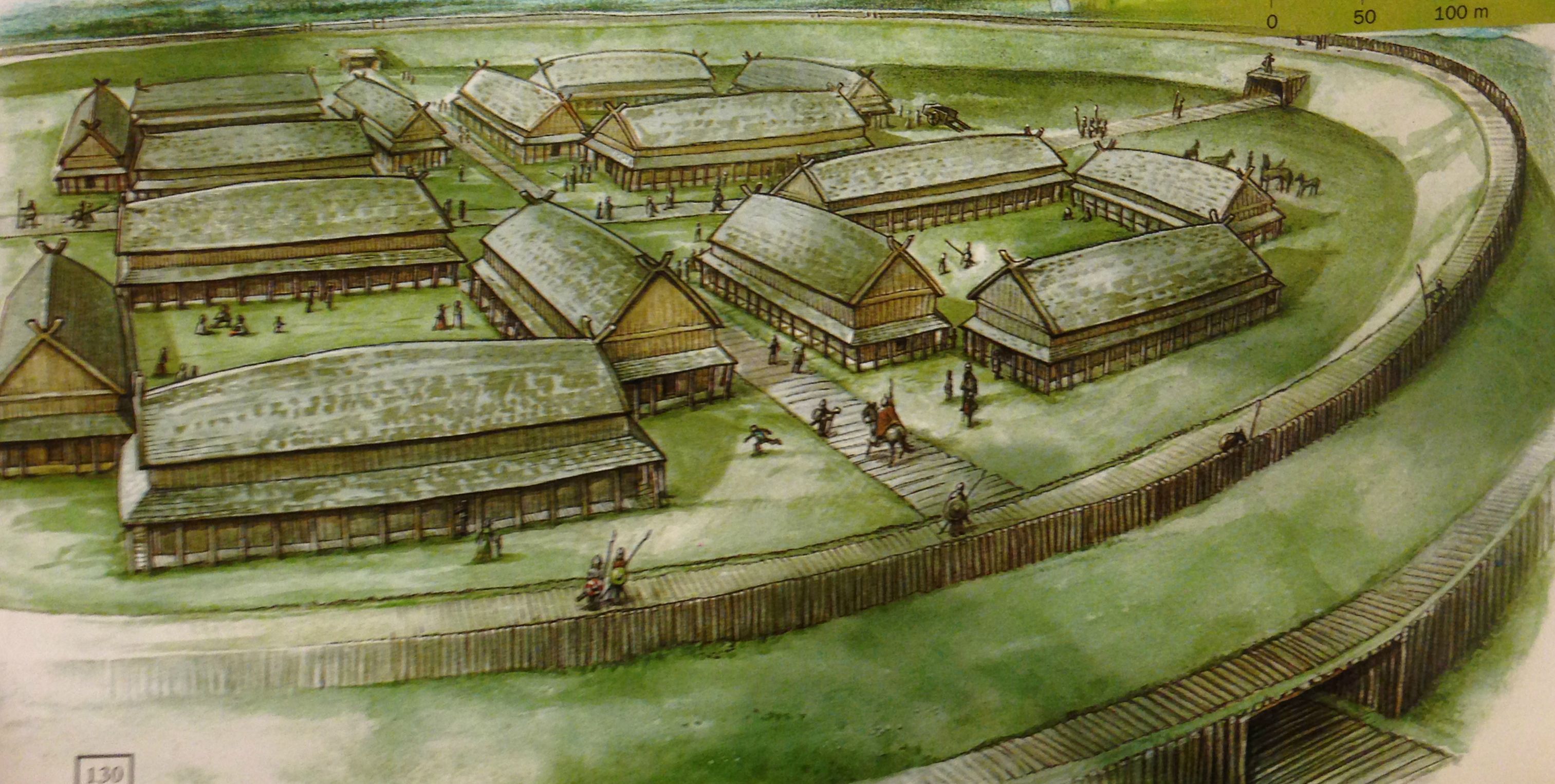
When the Viking ring (also known as Trelleborg) fortresses were discovered in Denmark, researchers were surprised: to a great extent, it came to light that they had previously underestimated both the Vikings’ organizational and technical capabilities of building military installations that would keep their enemies at a distance.

Eight of them have been dated to around 980 CE – the reign of King Gorm the Old’s son, King Harald I Bluetooth of Denmark (from who the Bluetooth technology has it's name).


These are:

-Aggersborg near Limfjorden, Denmark.
-Borgeby north of Lund at Lödde Å in Skåne, modern Sweden.
-Borrering near Køge, Zealand, Denmark
-Fyrkat near Hobro, Denmark.
-Nonnebakken in Odense, Denmark.
-Trelleborg near Slagelse, Denmark.
-Trelleborgen in Trelleborg, Skåne, modern Sweden
-Rygge, Østfold, Norway

The fortresses are characterized by a ring rampart with an appurtenant moat and four covering gate openings. They had a rigorous geometric street system, a division of the internal surface area into four square-shaped blocks. Within each of these blocks, there were four longhouses positioned in the form of farmhouses constructed around a quadrangle. All of the four facilities have a uniform and rigorous geometric architecture and a stringent symmetry, which clearly manifests itself in the fortifications’ circular forms and the gate openings’ placement with respect to the four corners of the world. Some historians think that the geometric design of the Trellenborgs was inspired by old Roman army camps. It has been estimated that the Trelleborg fortresses were built sometime around the year 980 A.D. However, it seems plausible to assume that the fortresses might not have been in existence for very long. And maybe they were operative for only a few years. We are quite sure, for example, that Fyrkat was wiped out after a raging conflagration and that it was not rebuilt.

Notwithstanding their homogeneity, each one of the fortresses has its own individual constructional features. The diameter of Aggersborg, for example, is 240 meters, which is roughly twice that of the other fortresses. At Trelleborg, there is a bailey consisting of 15 longhouses and protected by an outer rampart of its own, as well a trench. Cemeteries with remains of the Viking Era have been found at Fyrkat and Trelleborg.


When one arrived as a visitor to the fortresses, they must have appeared overwhelmingly impressive on account of their earthworks, their thick wooden palisades and their high moats and they probably seemed virtually impossible to conquer.

One moved through the gateway of the fortress and the ring ramparts, from where the guards stood and kept watch on whomever was arriving and suddenly found him/herself standing in the midst of the fortress’s layout, which was teeming with life. Taking the standards of the past into consideration, the houses, measuring more than 7 meters in width and almost 30 meters in length, with their outwardly bulging long walls, must have made their effect on the viewer as large halls of some sort.

When we also take into account that at Trelleborg and Fyrkat, there were four square-shaped blocks arranged around quadrangles while at Aggersborg, there were sixteen such square-shaped blocks with longhouses, it is easy to envision and sense the power that lay behind the construction of these fortresses.

The longhouses themselves were divided into three rooms, of which the middle room measured about 20 meters in length and was, in a number of instances, fitted with a langild (a long Iron Age/Viking fireplace, as opposed to a round or square one). Here the Vikings’ troops were quartered. It was here that they slept, repaired their personal equipment and played games that involved tossing dice.

From several of the halls, shouting, singing and laughter could be heard. But not all the houses were used as residences. From the blacksmith’s workshop, the hammer’s clanking against the anvil mingled with the joyful shouts and inside the storehouse buildings, the arithmetician might have quietly and calmly been busy checking on the army’s supplies – the rations would have to last for the whole winter. The short life and rapid abandonment of these fortress shows that political change at the end of the 10th century must have made them unnecessary.


reconstruction of the wall


Read More

Viking's unlucky trip to Dorset

In 2009 during the construction of the Weymouth Relief Road in Dorset archaeologists from Oxford made one of the most exciting, and disturbing, archaeological discoveries in Britain in recent years.

They have found a mass grave of 54 skeletons and 51 heads of men executed some time between AD 910 and 1030. Naked, beheaded, and tangled, the bodies of 51 young males  have been identified as brutally slain Vikings. For more than 1,000 years this bloody roadside act was forgotten, one of many atrocities in the long and violent struggle between the Anglo-Saxons and the Norse invaders. On November 13, A.D. 1002, Æthelred Unræd, ruler of the English kingdom of Wessex, “ordered slain all the Danish men who were in England,” according to a royal charter. This drastic step was not taken on a whim, but was the product of 200 years of Anglo-Saxon frustration and fear.

The 54 skeletons were all of males, almost all aged from their late teens to around 25 years old, with a handful of older individuals. They had all been killed at the same time with a large, very sharp weapon such as a sword. They had not been cleanly killed, as many of them had suffered multiple blows to the vertebrae, jawbones and skulls. One man had his hands sliced through, suggesting that he had attempted to grab the sword as it was being swung towards him.

They had no obvious battle wounds and were most likely captives. Judging from the lack of any remains of clothing or other possessions, they had probably been naked when they were thrown into the pit. There are more bodies than skulls, suggesting that a couple of the heads – perhaps of high-ranking individuals – were kept as souvenirs or put on stakes.

A chemical analysis of teeth from ten of the men showed they grew up in countries where the climate is far colder than Britain - with one individual thought to have come from within the Arctic Circle. Now we know that they were Viking mercenaries. We know that for their teeth, which some of them had grooves filed into his two front teeth. Archaeologists think it may have been designed to frighten opponents or show status as a great fighter. This is a typical for Jomsvikings, a group of warriors from eastern Denmark who were feared across Europe and became so notorious they spawned their own saga. The Jomsvikings were forbidden from showing fear, and if executed would request to face the blow as proof of their bravery.


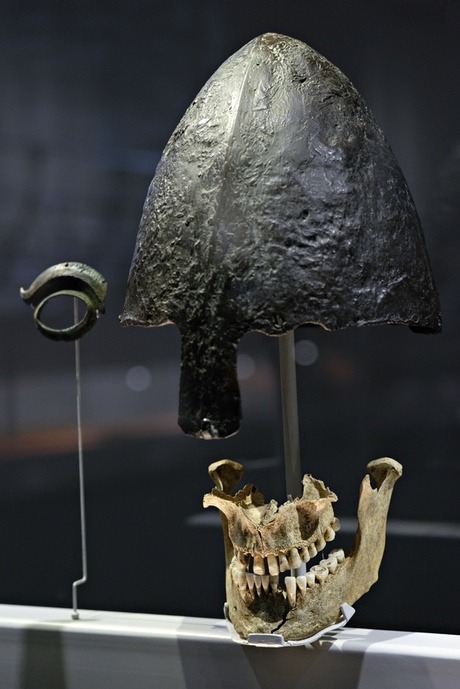
Few kilometers from the mass execution archaeologist have found helmet, axe and jawbone belonging to high rank Viking. There is a speculation that it's one of three missing heads from the Dorset execution. Maybe a leader of band whose head was taken as a trophy? Dating of the helmet gave us an answer that it's highly possible. 

Not only is it one of the most dramatic Viking finds of recent years, it is particularly important in providing a very different perspective to the usual view of Viking military success in England in that period


Read More
Powered by Blogger.

Popular Posts